Why South Korea?
South Korea, the world’s 13th-largest economy, has a population of nearly 52 million, one-fifth of whom live in the Seoul metropolitan area, making it the 13th most populous urban area in the world.
Korea’s economic fundamentals are strong, with its trade volume ranking 6th worldwide in 2022 and its foreign exchange reserves ranking 9th globally as of February 2023. The country’s stable economy continues to support business management and growth. Korea is the world’s 7th-largest exporter and 9th-largest importer. In 2023, foreign direct investment (FDI) reported to the Ministry of Trade, Industry and Energy (MOTIE) reached a record high of USD 32.7 billion, representing a 7.5% increase compared with the previous year. The country’s trade balance remains largely in surplus and is expected to remain so in the coming years.
Strong Economic Fundamentals
The Korean economy grew by an average of more than 3% throughout the 2010s. Although GDP contracted by 1% in 2020 due to the COVID-19 pandemic, the country quickly returned to its pre-pandemic level in less than a year, thanks to strong results in 2021. This was notably due to the “business continuity” strategy rapidly adopted by public authorities, which consistently sought to ensure the effectiveness of health measures to contain the spread of COVID-19 while avoiding disruptions to economic activity.
Today, despite a global environment still marked by significant economic and geopolitical uncertainty, particularly the war in Ukraine and geopolitical tensions in the Near and Middle East, Korea continues to demonstrate its resilience and strengths. The Korean government forecasts a recovery in economic growth, from 1.4% in 2023 to 2.2% in 2024.
The resilience of the Korean economy can also be attributed to an expansionary monetary policy and solid economic fundamentals: consumption (+1.8% year-on-year in H1 2024), investment (+9.5% year-on-year in H1 2024), exports (+7.4% year-on-year in H1 2024), public debt (50.4% of GDP in 2023), and unemployment (3.2% in H1 2024), which remain under control despite upward trends.
Growth Drivers
Korea’s key growth drivers include exports and R&D. Korean exports continued to grow, reaching USD 633 billion in 2023, placing Korea 13th among the world’s leading exporting economies.
The trend remained positive in the first half of 2024, with exports increasing by 13.8%, notably thanks to competitiveness gains in the semiconductor, electric vehicle, battery, and biotechnology sectors. R&D expenditure represents 4.96% of GDP, placing Korea 2nd worldwide. According to the World Intellectual Property Organization (WIPO), Korea ranked 10th in the Global Innovation Index, making it the second most innovative economy in Asia after Singapore for the second consecutive year in 2022.
As part of the Korean New Deal, the country’s economic recovery plan, the government plans to inject USD 133 billion by 2025 to create 1.9 million new jobs. The plan is divided into two components: the Digital New Deal and the Green New Deal. The BIG3 plan focuses more specifically on three industries of the future: zero-emission and autonomous vehicles, healthcare, and next-generation semiconductors.
France–Korea Opportunities
Korea is pursuing an open trade policy, reflected in the signing and implementation of 21 free trade agreements with 59 countries, covering 84% of global GDP in 2023.
For France, South Korea is a key partner in Asia. The free trade agreement between the European Union and South Korea, which entered into force in 2011, eliminated more than 99% of customs duties on manufactured and agricultural products and services. As a result, Korea is France’s third-largest trading partner in the region, behind China and Japan. Bilateral trade increased by 27% in 2023 to reach EUR 13.8 billion. France is notably Korea’s leading supplier of wine and cosmetics, its 3rd-largest supplier of leather goods, and its 4th-largest supplier of pharmaceutical products.
Moreover, Korean consumers associate French products with quality and show strong demand for French products across a wide range of sectors, including food and beverages, biotechnology, textiles, cosmetics, and high-value-added industrial products.
Korea’s attractiveness has continued to grow. With its increasing influence in Asia and its position between Japan and China—geographically, culturally, and in terms of consumer preferences—Korea represents an ideal market for companies looking to begin exporting to the region and test the potential of their products in Asia. Indeed, foreign direct investment (FDI) reached a record high of USD 32.7 billion in 2023.
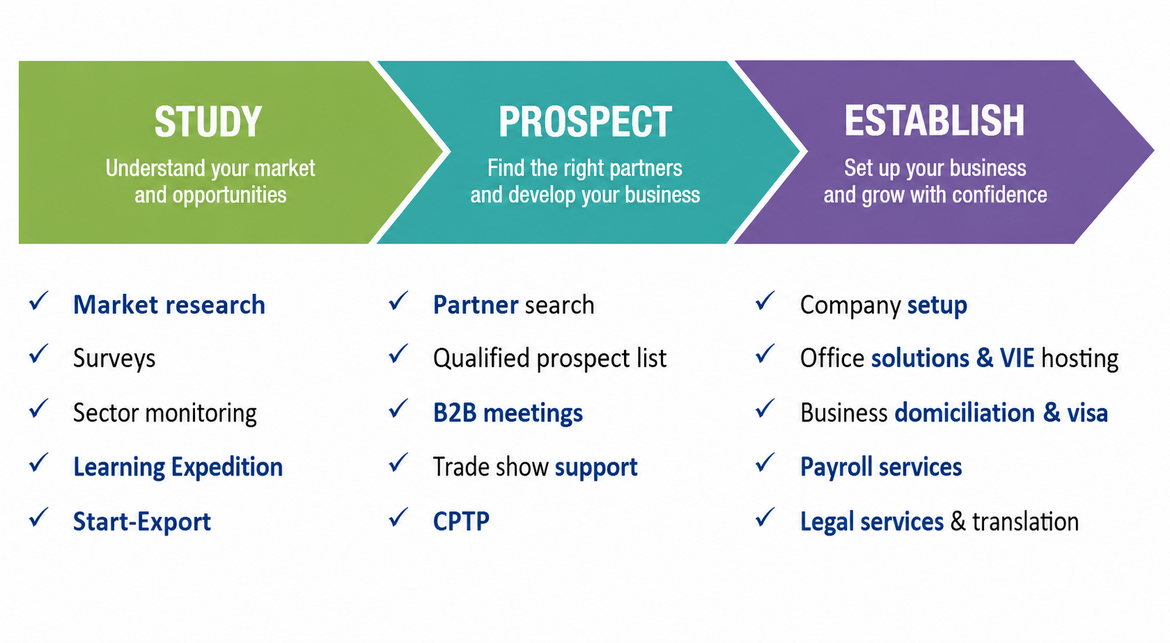
The FKCCI Supports You at Every Stage of Your Export Project